klaviyo platinum master partner

What Actually Drives Email Marketing Revenue? (It's Not Creative)
Email marketing "drives £36-42 per £1 spent" is widely quoted and mostly wrong. Here's what actually drives email revenue - and why most brands invest in the wrong lever.
Phill Manson, Founder, VALIX
7/13/20266 min read
Email marketing generates £36-42 for every £1 spent. You've seen that number. It's on every agency deck and half the platform homepages in the category.
It's also, for most brands, significantly wrong.
Not because email doesn't work. It's the highest-return digital channel most ecommerce brands have. The problem is the number itself: how it's calculated, what it hides, and what it leads brands to do with their send strategy.
This article makes three arguments. Audience data - not creative - drives the majority of email revenue. High send frequency inflates the metrics that justify sending more, while the list underneath quietly degrades. And platform-reported revenue is structurally overstated, which means the investment decisions built on it are calibrated against numbers that don't hold up.
The Value Driver Framework: Where Email Revenue Actually Comes From
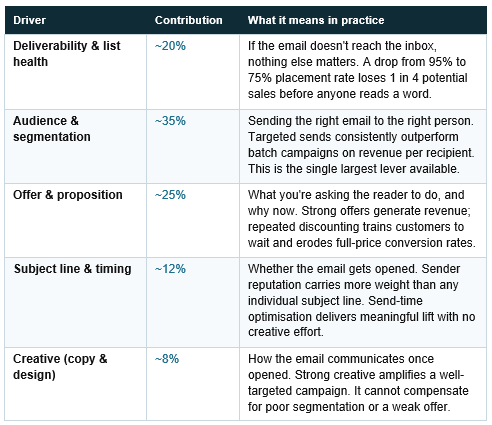
The most cited framework in direct response marketing is the 40-40-20 rule: 40% of a campaign's success comes from the list, 40% from the offer, 20% from the creative. It's more than 50 years old and it still holds. Applied to ecommerce email, deliverability adds a fifth variable.


Segmentation alone accounts for roughly four times the revenue impact of creative. Most brands have this inverted - in headcount, in agency scope, and in where the performance conversation goes when a campaign underperforms.
The most valuable investment in most email programmes isn't better design. It's better data: cleaner lists, sharper segmentation, more precisely timed sends.
The Risks of Overmailing
Email has a structural problem. The short-term incentive to send more is almost always in conflict with the long-term health of the list.
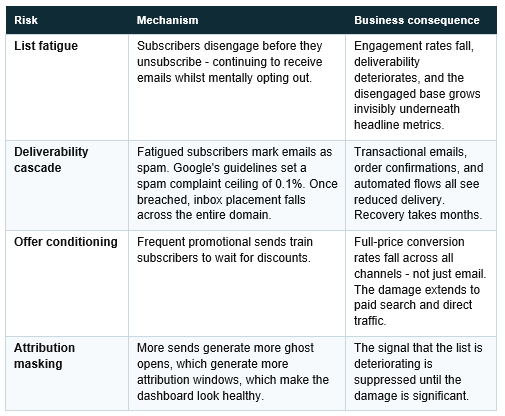
The dashboard distortion. Each additional send creates more attribution windows, which capture a larger share of purchases that were going to happen regardless. A brand that doubles send frequency will likely see attributed revenue rise - not because email is causing more purchases, but because more sends are claiming credit for ones that were already coming. Without holdout testing, this is invisible.
The lag effect. Lists decay at roughly 22-23% a year through unsubscribes, bounces, and inactivity, independent of send strategy. High frequency accelerates it. If acquisition is running hard in parallel, the list holds steady and the problem stays hidden. When acquisition slows, revenue follows three to six months later - by which point the conversation has usually moved on to diagnosing something else entirely.
Four risks compound on top of each other:
The Attribution Problem: Why Your Email ROI Is Probably Overstated
Email platforms attribute revenue on a time-window model: any purchase made within roughly five days of an open or click gets credited in full to that email. Reasonable in principle. The issue is how many of those "opens" are real.
In 2021, Apple introduced Mail Privacy Protection, which pre-loads email content - including tracking pixels - the moment an email is delivered, regardless of whether anyone opens it. An open event fires whether the email was read or not. Apple Mail makes up a significant share of tracked opens globally, and open rate inflation of 15-35% is typical depending on list composition.
A ghost open still starts a five-day attribution window. Any purchase in that window, through any channel, for any reason, gets credited to email. Your best customers - the ones who buy regularly regardless of what you send them - have their organic purchases systematically claimed by the channel.
What the gap tells you: compare your email platform's reported revenue against your ecommerce platform's actual order revenue, filtered to email-attributed orders. A persistent gap of 30-40% is normal - it reflects attribution inflation, not a tracking fault. A gap above 50% is worth investigating in your attribution window settings and engagement segment definitions.
Every budget decision, every frequency decision, every channel allocation gets calibrated against these figures. If they're inflated by 30-50%, the decisions built on them overweight email against other channels, and overweight send volume against list quality. Correcting for it usually points a programme toward sending less often, to a more targeted list - which also happens to be better for long-term list health.
The True Cost of the Channel
The £36-42-per-£1 figure uses the platform licence fee as the entire cost base. That's the wrong denominator for an investment decision. The real cost of running an email channel typically runs four to fifteen times the platform fee, depending on programme complexity.
A brand paying £400 a month in platform fees, with two days a week of internal resource, a £3,500 agency retainer, and £200 in supporting tools, is spending closer to £6,000 a month on email - not £400. The ROI calculation changes considerably once that's the real number.
There's a second distortion sitting underneath the first: a £100 attributed order at 40% gross margin is £40 of contribution, not £100. Promotional campaigns also inflate return rates, and it's the pre-return order value that typically gets attributed. A finance-grade ROI calculation uses contribution margin after returns, against the full programme cost - not the licence fee against gross revenue. The resulting number is lower than the benchmark everyone quotes. It's also the one that survives a conversation with finance.
What a Well-Run Email Programme Does Differently
Three things, and none of them require more creative resource. All of them require more analytical discipline.
It manages frequency as a strategic variable. Send cadence isn't a default - it varies by engagement level. Active subscribers sustain more contact. Anyone who hasn't engaged in 60 days or more should be on a reduced cadence. Global frequency caps stop overlapping campaigns and flows from pushing effective frequency far higher than anyone intended. The right question isn't "how often should we send?" It's "what frequency maximises revenue per recipient over twelve months, not this week?"
It measures revenue it caused, not revenue it observed. Holdout testing - suppressing a random slice of the list from a campaign and comparing purchase rates against the group that received it - is the most reliable way to isolate incremental revenue: the orders email actually caused, rather than orders it happened to be present for. Programmes that run regular holdout tests consistently find incremental revenue lower than platform-attributed revenue. The finding is more useful than the number - it shows you where the real leverage sits.
It separates list building from list protection. Acquisition and list quality run on different timescales and need different disciplines. Acquisition drives volume; quality determines how productive that volume stays. The best programmes track unsubscribe rate, spam complaint rate, and inactive percentage as leading indicators of future revenue, not as a post-mortem on past damage. A rising unsubscribe rate is a warning roughly three to six months ahead of the revenue impact.
Summary
Most ecommerce email programmes are optimised against the wrong things. They over-invest in creative relative to data quality. They send at high frequency to broad, unsegmented audiences because the dashboard numbers appear to justify it. They treat platform-reported revenue as a performance metric without accounting for the inflation that ghost opens and wide attribution windows introduce.
Email value is primarily a data problem, secondarily an offer problem. Creative - however important - comes third. Measurement integrity isn't a configuration detail sitting underneath the strategy. It's the thing the strategy has to stand on.
The brands getting the most out of email aren't sending the most email. They understand what they're actually measuring, treat frequency as a decision rather than a habit, and put the disproportionate share of their investment into the data layer that decides whether any given send reaches the right person at the right moment.
Frequently Asked Questions
Our email platform shows strong revenue numbers. Why should we be concerned?
Platform-reported email revenue can be inflated by Apple's Mail Privacy Protection, which generates open events whether or not a subscriber reads the email, and by default five-day attribution windows that claim credit for purchases that were happening anyway. The figure is useful for tracking relative change over time. It isn't an accurate measure of revenue email actually caused - holdout testing is the only reliable way to get that number.
What's the single highest-value action we could take on our email programme?
For most brands: improve segmentation and targeting before increasing send volume. Revenue per recipient - the number that actually drives long-term programme value - responds more to better targeting than to higher frequency. If you're currently sending largely unsegmented campaigns to the full list, that's where the leverage is.
How do we know if we're over-mailing?
Three signals, none of which need a holdout test to monitor: a rising unsubscribe rate, a spam complaint rate approaching 0.1%, and flat or declining revenue per recipient as send volume increases. All three are already in your platform reporting, and all three lead the revenue and deliverability problems rather than following them.
What's the true ROI of email marketing?
The widely cited £36-42 per £1 figure uses only the platform licence fee as the cost and gross attributed revenue as the return. A defensible calculation uses contribution margin after returns as the numerator, and a full programme cost - internal headcount, agency fees, creative, tooling, list acquisition spend - as the denominator. It produces a lower number. It's also one that holds up in a conversation with finance.
What does VALIX do?
VALIX is a UK-based Klaviyo Platinum Partner and CRM consultancy working with DTC and subscription ecommerce brands. We deliver programme audits, lifecycle strategy, flow architecture, segmentation design, and performance reporting. Get in touch at sales@valix.digital.
© VALIX Ltd | All rights reserved | Company registration number: 16669690
Registered office: 167-169 Great Portland Street, 5th Floor, London, W1W 5PF
Trading address: Challenge House Business Centre, Sherwood Dr, Bletchley, Milton Keynes, MK3 6DP | Privacy Policy
sales@valix.digital
VALIX is CYBER ESSENTIALS CERTIFIED

Subscribe to our newsletter
By signing up, you agree to receive email communications from VALIX Ltd, including marketing updates, promotional offers, industry insights, and information about our products and services. You understand that your personal information will be handled in accordance with our Privacy Policy, and you may unsubscribe from these communications at any time by clicking the unsubscribe link included in our emails or by contacting us directly.
Join our newsletter for the latest insights & strategies